
The Price Of Honour: How One Promise Turned Ned Stark Into The Most Tragic Father In Westeros
The Price of a Promise: Ned Stark, Jon Snow & the Politics of Necessary Deception
When Truth Becomes More Dangerous Than Lies
HISTORY often celebrates those who tell the truth. Yet history is equally shaped by those forced to bury it.
One of the greatest misconceptions surrounding Eddard “Ned” Stark is that he was merely an honourable man incapable of political calculation. In reality, his greatest political act was not leading armies during Robert’s Rebellion or serving briefly as Hand of the King. It was maintaining a single lie for nearly two decades.
That lie cost him his reputation, poisoned his marriage, scarred Jon Snow’s childhood and transformed Catelyn Stark into a woman burdened by resentment against an innocent child.
Yet that same lie preserved the life of the last legitimate Targaryen heir.
Ned Stark’s story therefore becomes less about honesty than about one of history’s oldest political dilemmas: Can deception become a moral obligation when truth guarantees innocent deaths?
It is a question that stretches far beyond the classical movie series Game of Thrones. Across Nigerian politics, African liberation struggles and global statecraft, leaders have repeatedly concealed truths—not always for selfish gain, but sometimes because transparency itself could ignite catastrophe.
Ned Stark stands at the centre of that uncomfortable debate.
The Tower of Joy: Where Honour Collided with Survival
The true story begins long before Winterfell.
At the end of Robert’s Rebellion, Ned Stark travelled south to the Tower of Joy in the Red Mountains of Dorne.
The war had already been won.
Prince Rhaegar Targaryen had fallen at the Trident.
King’s Landing had been sacked.
The Mad King was dead.
Yet three members of the Kingsguard—Ser Arthur Dayne, Ser Oswell Whent and Lord Commander Gerold Hightower—remained guarding an isolated tower.
Their presence revealed an extraordinary truth.
Kingsguard exist to protect the royal bloodline.
If they remained after the dynasty had fallen, then someone inside that tower still represented the future of House Targaryen.
Following a brutal battle in which only Ned Stark and Howland Reed survived, Ned entered the tower to discover his dying sister, Lyanna Stark, beside her newborn son.
Before dying, she extracted one final promise.
“Promise me, Ned.”
That promise became the axis upon which the entire history of Westeros turned.
Robert Baratheon’s Kingdom Was Built on Selective Justice
Many viewers underestimate why Lyanna feared Robert.
She was not imagining danger.
She understood political reality.
Robert Baratheon had already accepted—even celebrated—the killing of Rhaegar’s children, Aegon and Rhaenys.
Political revolutions rarely stop with defeating rulers.
They frequently eliminate entire bloodlines.
African history offers painful parallels.
Following coups and civil wars, victorious governments have often viewed surviving relatives of former rulers as permanent security threats.
Dynastic politics has repeatedly encouraged collective punishment rather than individual justice.
Whether among medieval monarchies, post-colonial African regimes or modern authoritarian governments, legitimacy has often been secured by erasing alternative claimants.
Jon Snow represented precisely such a claimant.
To Robert Baratheon, he would never have been a child.
He would have been the future centre of rebellion.
The Lie That Destroyed a Marriage
Ned returned north carrying two children.
One was Robb Stark.
The other was Jon Snow.
To protect Jon, Ned allowed the entire realm—including his own wife—to believe that he had committed adultery during the war.
For seventeen years Catelyn Stark believed she was living beside the living evidence of her husband’s betrayal.
Every family dinner.
Every lesson.
Every hunting expedition.
Every celebration.
Jon’s very existence silently accused Ned.
Yet Ned never defended himself.
Not once.
The emotional cruelty of that silence becomes almost unbearable because he watched Catelyn suffer under an entirely false belief.
He allowed the woman he loved to think less of him because revealing the truth would almost certainly have condemned his nephew to death.
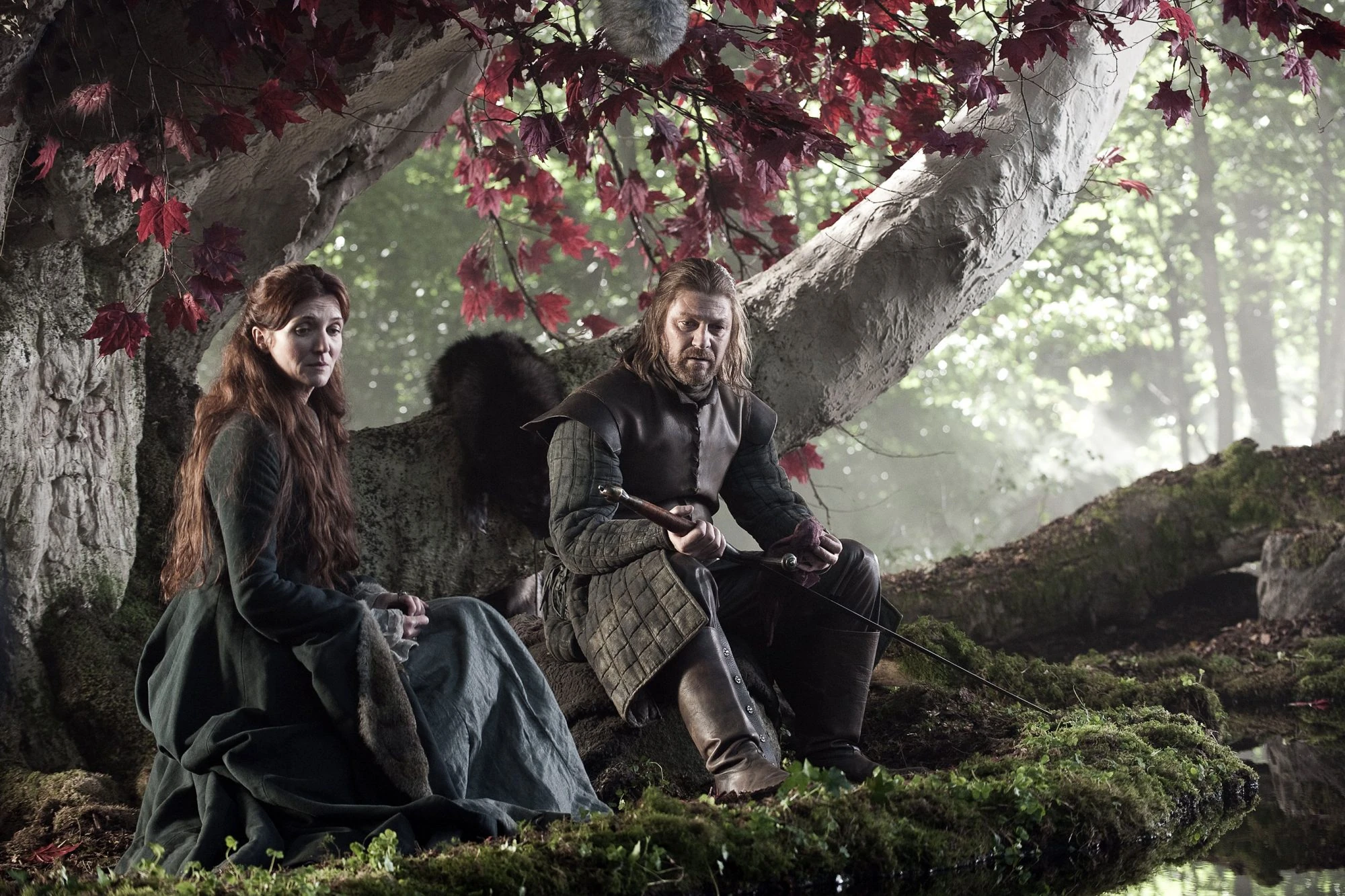
Why Ned Never Told Catelyn
Many fans argue that Ned should simply have trusted his wife.
The novels suggest something more complicated.
While imprisoned in King’s Landing, Ned privately reflects:
“What would Catelyn do if it came down to Jon’s life or the lives of her own children?”
His answer is devastating.
He does not know.
That uncertainty explains everything.
This was never about doubting Catelyn’s loyalty.
It was about recognising maternal instinct.
Every society understands this instinct.
Whether in Nigerian villages, South African townships, Ethiopian highlands or American suburbs, parents overwhelmingly prioritise their own children above abstract political ideals.
Had Catelyn known Jon’s identity, she herself would have become guilty of concealing treason.
She would have carried the burden of protecting a prince whose existence threatened every one of her children’s futures.
Ned concluded that ignorance was the only protection he could give her.
Sometimes the safest witness is the one who knows nothing.
Power, Secrecy & the Logic of Political Survival
Ned’s decision illustrates an enduring principle of governance.
The fewer people who know a dangerous secret, the greater its chances of survival.
Modern intelligence agencies operate under exactly this principle.
Compartmentalisation saves lives.
African liberation movements frequently adopted similar strategies during anti-colonial struggles.
Need-to-know structures protected resistance networks from infiltration.
Even democratic governments routinely classify information where disclosure could endanger national security.
Ned unknowingly practised precisely this logic.
He isolated the secret within himself.
In doing so, he transformed personal suffering into political security.

Catelyn Stark: The Hidden Victim
The tragedy extends beyond Ned.
Catelyn herself becomes one of the story’s greatest casualties.
She was never inherently cruel.
She was operating from incomplete information.
Believing Jon to be Ned’s bastard, she interpreted his presence as a permanent threat to Robb’s inheritance.
Every smile Jon received from Ned became another reminder of supposed betrayal.
Years of unresolved suspicion hardened into emotional distance.
Her infamous wish that Jon, rather than Bran, had fallen from the tower illustrates not innate malice but accumulated psychological exhaustion.
Ironically, Jon was not her rival’s son.
He was her nephew by marriage.
Had she known the truth, her entire relationship with him would almost certainly have changed.
Yet she died at the Red Wedding never discovering it.
Jon Snow: Growing Up Without an Identity
Jon paid perhaps the highest personal price.
He belonged everywhere and nowhere.
Raised as a Stark but denied the Stark name.
Loved by some.
Rejected by others.
Unable to inherit.
Unable to fully belong.
Children construct their identities through certainty.
Jon grew up with uncertainty.
That emotional isolation eventually pushed him toward the Night’s Watch—a decision that shaped the future of humanity itself.
Ironically, Ned intended to reveal the truth only after Jon took his vows.
Once Jon abandoned inheritance rights, he no longer posed a political threat.
Only then did Ned judge it safe to tell him everything.
History intervened first.
Joffrey ordered Ned’s execution.
The truth died with him.
A Nigerian & African Reading: When Leaders Carry Dangerous Secrets
Ned Stark’s dilemma echoes numerous African political experiences.
Across Nigeria and much of Africa, leaders have often withheld information under the justification of preserving national unity or preventing instability.
Sometimes such secrecy prevented immediate violence.
Sometimes it merely postponed larger crises.
Ethnic tensions, constitutional negotiations, military transitions and peace agreements frequently depend upon carefully managed information.
The challenge lies in distinguishing legitimate statecraft from manipulative secrecy.
Ned represents the rare example where secrecy appears motivated almost entirely by protection rather than personal ambition.
Yet even noble secrecy produces victims.
His marriage suffered.
Catelyn suffered.
Jon suffered.
Truth delayed often becomes emotional debt passed across generations.
The Global Lesson: Security Versus Transparency
Modern democracies continue wrestling with the same paradox.
How much should governments reveal?
When should intelligence remain classified?
Can leaders conceal facts without betraying public trust?
The debate stretches from Cold War espionage to contemporary counterterrorism.
Absolute transparency can expose vulnerable lives.
Absolute secrecy breeds authoritarianism.
Ned Stark demonstrates the human cost of attempting to navigate the narrow space between both extremes.
The Cruel Victory of Honour
Ultimately, Ned failed politically.
He lost his office.
Lost his freedom.
Lost his life.
Yet by his own standard, he achieved complete success.
Jon Snow survived.
That single objective justified every sacrifice.
Unlike Littlefinger, who manipulated people for power, or Tywin Lannister, who sacrificed family for dynasty, Ned sacrificed himself for one vulnerable child.
His reputation became collateral damage.
His marriage became collateral damage.
Even his identity as the most honourable man in Westeros became collateral damage.
Yet honour, paradoxically, was exactly what compelled him to lie.
The Politics of Love
Ned Stark’s greatest achievement was not defeating armies or governing the North.
It was carrying unbearable loneliness without asking anyone else to share it.
His story reminds us that leadership is not always measured by victories.
Sometimes it is measured by the burdens one silently carries so that others never have to.
Across Nigeria, Africa and the wider world, politics often celebrates those who seize power.
Game of Thrones quietly suggests another measure of greatness.
The finest leaders may instead be those willing to lose everything—including their own good name—to protect those unable to protect themselves.
Ned Stark never won the Game of Thrones.
But he won the only battle that truly mattered to him.
Jon Snow lived.
