
Schooling Is Not Enough: The Employability Challenge Facing Nigerian Youth
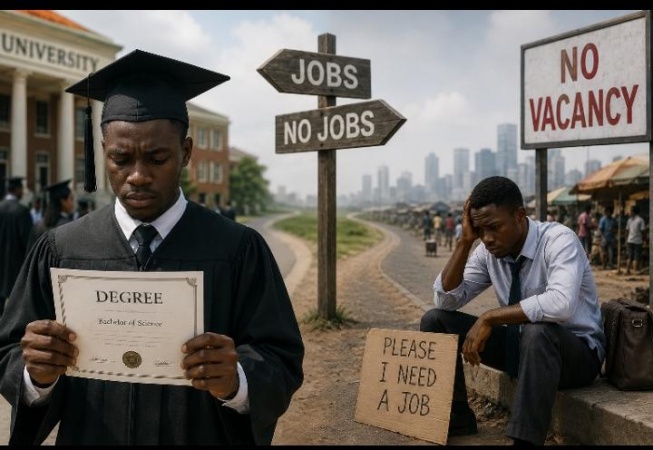
A growing number of graduates are discovering that academic qualifications alone offer little protection against unemployment as employers increasingly seek practical skills and workplace readiness.
The Paradox of Graduate Unemployment
NIGERIA continues to produce thousands of university graduates annually, yet unemployment and underemployment remain persistent concerns.
This paradox has become one of the country’s most pressing socio-economic challenges.
Despite years of study and significant financial sacrifices by families, many graduates find themselves unable to secure jobs that correspond with their qualifications. Some remain unemployed for years, while others settle for low-paying opportunities outside their chosen professions.
The situation has sparked renewed debate about whether the country’s education system is adequately preparing young people for today’s labour market.
The Changing Nature of Work
The workplace of today differs significantly from that of previous generations.
Technological advancement, automation, globalization, and evolving business models have transformed employer expectations.
Recruiters increasingly seek candidates who possess practical experience, digital competencies, innovative thinking, and the ability to solve complex problems.
In many sectors, employers are less concerned about where candidates studied and more interested in what they can actually accomplish.
This transformation has created new challenges for graduates whose education remains heavily focused on theory rather than practical application.
The Education-Industry Disconnect
A major factor contributing to graduate unemployment is the persistent gap between academic training and workplace realities.
Many educational programmes continue to emphasize examinations and theoretical knowledge while providing limited opportunities for hands-on learning.
Consequently, graduates often enter the labour market with impressive academic credentials but insufficient practical exposure.
Employers frequently report difficulties finding candidates with the skills needed to operate modern equipment, manage projects, analyze data, communicate effectively, or adapt to changing workplace environments.
This disconnect contributes significantly to unemployment even in sectors where job opportunities exist.
The Rising Value of Skills
Across the world, skills-based hiring is gaining momentum.
Professional certifications, vocational expertise, technical training, entrepreneurial experience, and digital competencies are increasingly influencing hiring decisions.
Fields such as software development, digital marketing, graphic design, cybersecurity, data analysis, project management, and renewable energy have demonstrated that practical skills can significantly enhance employability.
For many employers, evidence of competence often outweighs academic distinctions.
This trend is encouraging students to pursue additional training and professional development alongside formal education.
Building a Workforce for the Future
Experts advocate a comprehensive approach to improving graduate employability.
Universities and polytechnics are being encouraged to strengthen partnerships with industry, expand internship opportunities, and modernize curricula to reflect changing economic realities.
Students are also urged to take advantage of online learning platforms, vocational programmes, entrepreneurship training, and volunteer opportunities that can enhance their practical experience.
By acquiring relevant skills before graduation, young people can improve their competitiveness in an increasingly demanding labour market.
From Qualification to Competence
The conversation surrounding unemployment is gradually shifting from certificates to capability.
Education remains a critical foundation for personal and national development, but it is no longer sufficient on its own.
In today’s knowledge economy, success increasingly depends on a combination of academic achievement, practical skills, adaptability, and continuous learning.
As Nigeria seeks to harness the potential of its youthful population, the challenge will be ensuring that graduates leave educational institutions not only with certificates but also with the competence required to thrive in the modern workplace.
The future of employment may therefore depend less on what is printed on a certificate and more on the skills individuals bring to the table.
