
Billions Invested, Millions Still At Risk: Why Malaria Continues To Define Nigeria’s Public Health Crisis
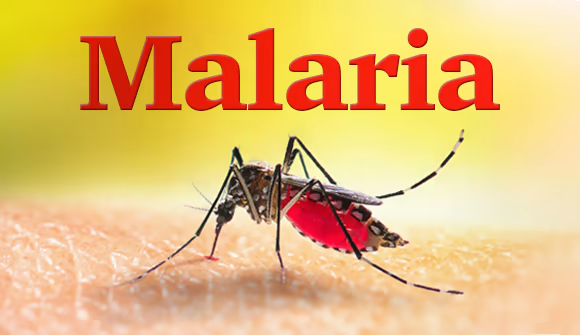
Despite decades of international funding, expanded prevention campaigns and measurable progress in reducing infections, Nigeria continues to shoulder the world’s highest malaria burden, exposing deep structural inequalities in healthcare, sanitation, infrastructure and public policy.
FOR many Nigerian families, malaria is no longer viewed as an occasional illness brought on by the rainy season. Instead, it has become a recurring economic, social and public health emergency that quietly drains household incomes, disrupts children’s education, weakens workforce productivity and places enormous pressure on an already stretched healthcare system.
This contradiction lies at the heart of Nigeria’s malaria challenge. Although billions of naira and hundreds of millions of dollars have been invested over the past two decades to combat the disease, Nigeria still accounts for nearly one-quarter of all malaria infections worldwide and almost one-third of global malaria deaths.
The country’s experience raises a fundamental policy question: why has significant financial investment failed to eliminate a disease whose prevention and treatment methods are already well understood?
The Human Face of Nigeria’s Malaria Burden
For 28-year-old Favour Okoh, who lives in Kuchiako Extension in Kuje Area Council of the Federal Capital Territory (FCT), malaria represents far more than a medical diagnosis.
Every fever suffered by her three-year-old son triggers another financial crisis. Hospital consultations, laboratory tests and antimalarial drugs compete directly with food, rent and school expenses.
Like millions of low-income households, her family sometimes purchases only part of the prescribed medication or turns to nearby patent medicine vendors because of financial constraints.
Around their neighbourhood, stagnant water, blocked drainage channels and indiscriminate refuse disposal provide ideal breeding sites for mosquitoes, ensuring that the disease remains a persistent threat despite widespread awareness campaigns.
Although the household owns insecticide-treated mosquito nets, the realities of unreliable electricity supply and excessive heat make consistent usage difficult.
For families like the Okohs, malaria is no longer simply a seasonal infection—it has become an entrenched cycle of illness and poverty.
Progress That Masks Persistent Inequality
Nigeria has undoubtedly recorded measurable achievements in malaria control.
Official figures indicate that national malaria parasite prevalence declined from approximately 42 per cent in 2010 to about 15.2 per cent in 2025.
Health experts attribute this improvement to sustained distribution of insecticide-treated mosquito nets, wider availability of rapid diagnostic testing, improved access to artemisinin-based combination therapies, seasonal malaria chemoprevention for children and stronger disease surveillance systems.
These gains informed the launch of the National Malaria Strategic Plan (2026–2030), which seeks deeper collaboration between government, development partners, civil society organisations and the private sector.
According to the RBM Partnership to End Malaria, the progress demonstrates that coordinated investment can produce measurable health outcomes.
Yet national averages conceal significant disparities.
Why Nigeria Remains the World’s Malaria Capital
Despite falling prevalence rates, Nigeria still bears the heaviest malaria burden globally.
The 2025 World Malaria Report estimates that the country accounts for approximately 24.3 per cent of global malaria infections and over 30 per cent of malaria-related deaths.
More than 97 per cent of Nigerians live in malaria transmission zones, with children under five years of age and pregnant women remaining the most vulnerable populations.
Public health experts argue that this contradiction reflects unequal progress rather than policy failure alone.
Urban centres with stronger infrastructure, efficient drainage systems and better healthcare access have experienced substantial improvements.
However, rural communities, peri-urban settlements and rapidly expanding satellite towns continue to experience environmental conditions that favour year-round mosquito breeding.
Infrastructure Deficits Fuel Transmission
The Federal Capital Territory illustrates this growing divide.
Health authorities report that malaria prevalence in Abuja declined from 18.8 per cent in 2021 to approximately 7.9 per cent in 2025.
Nevertheless, significant differences remain between affluent districts such as Maitama, Asokoro and Wuse and less-developed communities including Kuje, Nyanya, Karu, Gwagwalada and parts of Bwari.
Poor drainage systems, stagnant water, inadequate waste management and weak primary healthcare infrastructure continue to sustain mosquito populations in many of these communities.
Public health specialists warn that national success stories often conceal localised hotspots where transmission remains stubbornly high.
Funding Is No Longer the Only Challenge
Between 2020 and 2024, Nigeria secured approximately 364 million dollars from multilateral development institutions, including the World Bank, African Development Bank and Islamic Development Bank, to strengthen malaria control across thirteen states.
Additional support came from the Global Fund, the U.S. President’s Malaria Initiative, the World Health Organisation, UNICEF and numerous international partners.
These resources financed mosquito net campaigns, diagnostic kits, medicines, health worker training, surveillance systems and preventive treatment programmes.
However, health economists increasingly argue that future success depends less on raising additional funds than on ensuring equitable access to existing interventions.
Many Nigerians still finance between 60 and 76 per cent of malaria treatment costs directly from their own pockets because health insurance coverage remains limited.
For low-income families, a single malaria episode can consume an entire week’s income.
The Hidden Economic Cost
The consequences extend far beyond healthcare.
Economists estimate that malaria costs Nigeria roughly 1.1 billion dollars annually through lost productivity, school absenteeism, reduced labour output and increased healthcare expenditure.
Repeated illness also discourages investment, weakens household savings and contributes to long-term poverty, particularly in rural communities.
For employers and government alike, malaria remains a significant barrier to economic growth.
A Shift Towards Prevention
Health authorities are increasingly adopting integrated prevention strategies.
The FCT Administration recently launched a seasonal malaria chemoprevention programme targeting more than one million children between three and fifty-nine months of age across the six Area Councils.
Nigeria is also gradually expanding malaria vaccination for eligible children.
However, experts caution that vaccine deployment alone will not eliminate malaria without reliable cold-chain infrastructure, sustained funding, trained healthcare workers and community acceptance.
Beyond Mosquito Nets
Leading malaria experts argue that Nigeria’s next phase of malaria control must extend beyond the traditional focus on mosquito nets and medicines.
Priority interventions include improved drainage systems, environmental sanitation, stronger primary healthcare facilities, expanded health insurance coverage, uninterrupted supplies of medicines and diagnostic equipment, increased domestic financing and greater community participation.
Equally important is changing public behaviour.
Lagos State has demonstrated how improved diagnostic practices can reduce unnecessary malaria treatment.
Health Commissioner Prof. Akin Abayomi has repeatedly warned against treating every fever as malaria without laboratory confirmation, describing the widespread practice as “Wahalaria.”
The Road Ahead
Nigeria has demonstrated that malaria can be controlled.
What remains unresolved is whether the benefits of scientific progress and financial investment can reach the communities where the disease continues to thrive.
Until environmental conditions improve, healthcare becomes more accessible and prevention strategies are implemented equitably, Nigeria is likely to retain the unwanted distinction of being the world’s malaria capital.
For millions of families, success will not be measured by declining national statistics alone but by the day malaria ceases to determine how they spend their income, educate their children and plan their futures.
