
When The Law Fails The Realm: The Institutions That Kept Westeros At War
A Kingdom Governed by Precedent, Not a Constitution
WESTEROS presents itself as a kingdom governed by ancient customs, royal authority and inherited rights. Yet beneath that appearance lies a legal order that is remarkably fragmented.
There is no single constitutional document clearly defining the relationship between the Iron Throne, the great houses, the Faith, local lords and military institutions. Instead, governance depends heavily on precedent, custom and the personal authority of whoever occupies the throne.
That arrangement can function when political actors broadly agree on the rules. The problem begins when powerful individuals interpret those rules differently.
The resulting instability is one of the central features of Westerosi politics.
The realm’s legal traditions do not simply fail to prevent conflict. In several cases, they create incentives for powerful people to turn legal mechanisms into political weapons.
Trial by Combat: When Justice Becomes a Contest of Power
Few institutions expose this contradiction more clearly than trial by combat.
Under Westerosi law, an accused person can invoke trial by combat, with champions fighting on the parties’ behalf. Knights and nobles have the right to demand such a trial, while non-warriors can also rely on champions. The outcome is determined by combat rather than by a conventional assessment of evidence.
This does not mean that every defendant can simply purchase freedom. The institution is embedded within a broader legal system involving judges, testimony and sworn evidence.
Nevertheless, trial by combat creates a fundamental problem.
The truth and the victor are not necessarily the same thing.
Tyrion Lannister’s trial over Joffrey’s murder demonstrates the danger. His champion, Oberyn Martell, nearly defeats Ser Gregor Clegane and even extracts an apparent confession concerning the murder of Elia Martell and her children. Yet Oberyn’s momentary triumph does not translate into legal justice because Gregor kills him.
Tyrion therefore loses despite the evidence emerging during the combat.
The institution effectively transforms a question of guilt into a question of who can survive a duel.
That is a profound structural weakness.
A wealthy or politically connected defendant can potentially obtain a formidable champion. A poor person cannot necessarily command equivalent resources.
The result is a justice system in which social power can influence physical representation inside the courtroom.
Nigeria & Africa: Justice Cannot Depend on Who Has the Strongest Champion
The Westerosi example has obvious relevance to modern societies, although contemporary legal systems operate under very different principles.
Nigeria’s constitutional order is built around formal courts, evidence, due process and rights of the accused. Yet the broader social environment still demonstrates why equal access to justice matters.
A legal system may possess excellent rules on paper while producing unequal outcomes if citizens have dramatically different access to competent lawyers, financial resources, institutional connections or political influence.
Across Africa, this tension has appeared repeatedly in debates over judicial independence, access to justice, customary authority and the unequal treatment of citizens.
Westeros takes the problem to its most literal extreme.
Instead of asking, “What actually happened?”, trial by combat can ultimately ask, “Who can produce the champion capable of winning?”
That is not necessarily justice.
It is institutionalised competition.
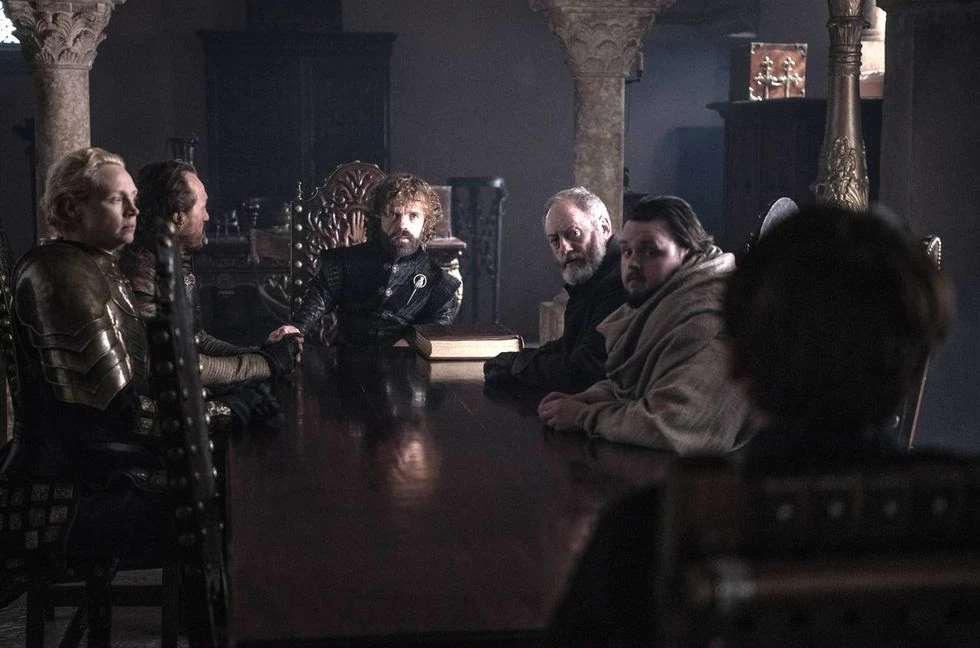
The Great Council & the Politics of Succession
Succession presents an even deeper institutional problem.
The Great Council of 101 AC was convened after Prince Baelon Targaryen’s death to determine who should succeed King Jaehaerys I. Multiple claims were considered, but Viserys ultimately emerged as the preferred candidate.
The problem is not simply that Westeros preferred male succession.
The deeper problem is that the realm never developed a sufficiently clear and consistently enforceable constitutional settlement governing succession.
The Great Council became an enormously influential precedent, but precedent is not the same thing as a comprehensive constitution.
That distinction becomes catastrophic during the Dance of the Dragons.
Rhaenyra Targaryen’s claim exposes the unresolved question: if a king publicly names a daughter as heir, can an earlier political precedent automatically override that decision?
Westeros never establishes an uncontested answer.
Instead, rival factions interpret tradition according to political necessity.
The result is civil war.
Thus, the problem is not simply sexism within the succession system, although gender clearly matters. It is also constitutional ambiguity.
When the rules governing the transfer of supreme power are uncertain, competing elites have an incentive to settle constitutional questions through armies rather than courts.
When Precedent Becomes a Political Weapon
This problem has recognizable parallels in real political history.
Countries with unclear succession arrangements frequently experience political crises when leaders die, resign or become incapacitated.
In several African states, constitutional disputes surrounding presidential succession, term limits, military intervention or disputed electoral mandates have demonstrated the danger of rules whose interpretation depends excessively on political power.
A constitution is most valuable when powerful actors are constrained by it.
A precedent becomes dangerous when powerful actors can selectively invoke it whenever it serves their interests.
Westeros repeatedly makes that mistake.
Its ruling class treats historical precedent as sacred when convenient and negotiable when inconvenient.

The Night’s Watch: Punishment or Political Disposal?
The Night’s Watch presents another unusual feature of Westerosi law.
Taking the black is sometimes used as an alternative to harsher punishment, including execution. The Watch receives disgraced nobles, criminals, bastards and other unwanted men, while those who voluntarily take the vows surrender marriage, land and family life. Once sworn, deserters face death.
This arrangement has a practical function.
The realm can remove dangerous or disgraced individuals without necessarily executing them.
However, it also creates an uncomfortable relationship between justice and political expediency.
The state can effectively relocate undesirable people to a remote military institution while presenting the arrangement as punishment and service.
The Watch therefore becomes simultaneously a penal institution, a military force and a political dumping ground.
That ambiguity weakens the distinction between justice and disposal.
The Right of First Night: When Custom Becomes Institutionalised Abuse
Perhaps the clearest example of the conflict between law and custom is the Right of First Night.
The practice supposedly allowed a lord or king to claim sexual access to a newly married commoner woman.
Yet Queen Alysanne Targaryen challenged the custom and ultimately persuaded Jaehaerys I to abolish it in 58 AC. Thereafter, a lord who continued practising it could be treated as committing rape.
The significance extends beyond the custom itself.
It demonstrates how institutions can preserve injustice simply because the injustice is old.
The argument that something has “always been done” can become a substitute for moral and legal scrutiny.
That phenomenon is hardly confined to Westeros.
African societies, like societies everywhere, have wrestled with conflicts between customary practice and modern constitutional rights. The difficult task is not simply preserving tradition or destroying it. It is determining which customs remain compatible with human dignity and contemporary law.
Queen Alysanne’s intervention illustrates an important principle:
Tradition does not automatically acquire legitimacy merely because it is ancient.
Inheritance & the Problem of Child Rulers
Westeros also relies heavily on hereditary succession.
That creates another vulnerability.
A castle, title and military command can pass to a child who possesses the correct bloodline but lacks the experience required to govern.
The issue is not that Westerosi law literally mandates that children must rule without supervision. Regency arrangements exist precisely because young monarchs cannot govern independently. Aegon III, for example, inherited the Iron Throne as a child and was governed through a regency council.
The deeper problem is that inheritance determines legitimacy before competence becomes relevant.
Once a child inherits a major title, competing adults can fight over who controls the child, the regency and the surrounding political machinery.
That creates opportunities for assassination, manipulation and civil conflict.
The political struggle is therefore displaced from “Who should rule?” to “Who controls the person who technically rules?”
The Nigerian & African Dimension of Political Succession
This question has real-world resonance.
Modern constitutional systems generally attempt to separate succession from personal inheritance. Yet leadership transitions across Africa have repeatedly shown how dangerous political uncertainty becomes when institutions are weak.
The issue is not simply whether a successor is young or inexperienced.
The deeper issue is whether institutions are strong enough to prevent competing elites from capturing the succession process.
Westeros lacks that institutional depth.
Its politics repeatedly reduces national stability to the fortunes of individual families.
When the family survives, the system survives.
When the family fractures, the state fractures with it.
A Kingdom Without Institutional Memory
The greatest weakness of Westeros may therefore not be any single law.
It is the absence of a sufficiently coherent institutional framework capable of resolving disagreements before they become wars.
Trial by combat substitutes violence for evidence.
Succession disputes transform precedent into competing claims.
The Night’s Watch blurs punishment and military service.
The First Night demonstrates how custom can survive until powerful reformers challenge it.
Hereditary inheritance repeatedly converts family disputes into national crises.
The common thread is clear.
Westeros possesses laws, but law does not consistently possess the political power necessary to restrain those who matter most.
That distinction is crucial.
A state does not become lawful merely because it has laws.
It becomes lawful when rulers, nobles, institutions and citizens are meaningfully constrained by them.
The Real Crisis Was Institutional
The wars of Westeros are often presented as battles between ambitious individuals.
But beneath the personalities lies a deeper structural problem.
The realm repeatedly asks political institutions to solve problems they were never designed to handle.
Its justice system can be manipulated.
Its succession rules remain ambiguous.
Its customs compete with formal law.
Its punishments can serve political convenience.
Its hereditary system allows family disputes to become national emergencies.
Consequently, Westeros does not merely suffer from bad rulers.
It suffers from weak institutional architecture.
That distinction matters because replacing one ruler with another cannot permanently repair a system that continues producing the same incentives.
The Iron Throne changes occupants.
The underlying vulnerabilities remain.
