
Edo North: Gold District Of South-South Nigeria
BY DONALD INWALOMHE
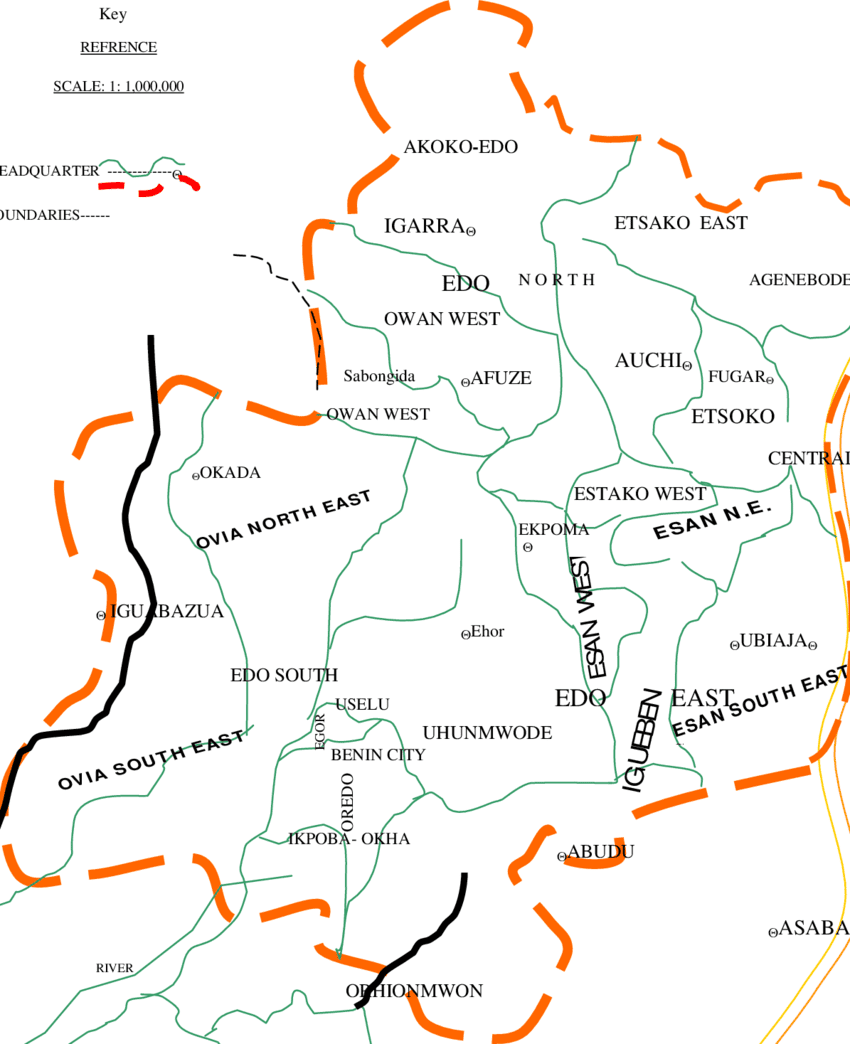
TODAY, Edo North is now the gold district of Edo State and South-South Nigeria yet there is no good road in Edo North. Edo State needs a laboratory to test solid minerals. Gold deposits, economic diversification, and illegal mining are risks in Edo North, Edo State, specifically areas like Ososo, Ojirami, Dangbala, Atte and Uneme Eruru in Akoko-Edo. Gold is mined in Ogbido, Uluoke, Iyuku, Imekhe all in Uzairue, Etsako West. Okpella remains the centre of gold mining in Etsako East. There is presence of gold in Owan East and Owan West local governments. There are many companies operating in Edo North.
Various groups compete for illegal mining of gold deposit. Unauthorised mining activities in Akoko Edo, Etsako West, Etsako East, Owan East and Owan West Local Governments in Edo State continue to peak as non-state groups struggle over the unregulated gold mining sites. And this has continued to fuel the rising threat within and around the area.
Edo North gold belt hosts multiple cement plants—specifically three operated by BUA Group and one by Dangote Group—primarily concentrated around Okpella in the Etsako East Local Government Area. BUA Group Plants: Operates multiple major cement production lines/plants in Okpella, including the revived Edo Cement factory and expanded modern production facilities. Dangote Cement Plant: Maintains a strategic, high-capacity manufacturing plant in Okpella. Additional Plants: Planned or emerging footprints extend the tally in the region, such as developments targeting areas like Egbetua-Ososo in Akoko-Edo.
Arguably, the human capital deficits in Okpella, Etsako East, Ososo, Dangbala and Uneme Eruru, Akoko- Edo and lack of effective government presence in mining areas are push-factors to the cut-throat engagement of the local population in a quest for sustenance and survival. Adequate government regulations will, to a large extent, address the losses to illegal mining. Part of the revenue accruing from regulated mining should be used to drive development in the area. If the federal government can maximise revenue from mining activities, it can fund developmental projects that will improve the living condition of the people. Without a government-led and community-centred approach, illegal mining and conflicts in Nigeria’s unofficial theatre of war will continue to reinforce each other and pose numerous existential crisis in the region
Gold Locations: Donald identified commercial and artisanal gold deposits across areas such as Dangbala, Atte, and Ososo in the Akoko-Edo, Etsako West, Etsako East, Owan East and Owan West local government areas of Edo North.
Illegal Mining Security Risks: I must warn about the influx of thousands of illegal miners into Edo-North communities. There are environmental damages and security threats mirrored challenges seen in northwestern Nigeria.
Regulatory Failure: My investigations pointed out that illegal mining operations and foreign incursions were often exacerbated by local regulatory gaps and complicity among local actors.
Economic Potential: I want to highlight that illicit risks and harnessing solid minerals like gold and marble properly could vastly diversify Edo State’s revenue away from over-reliance on oil.
The mining of solid minerals in Edo state has been controversial. There is no laboratory to test the type of solid minerals that companies are mining in Edo North. There is no database to know the number of companies that are operating in solid mineral sector in Edo North. Who are the companies that bought solid mineral deposits in Edo North? The Federal Government cannot give account of the revenue from the mining of solid minerals in Edo North. The people of Edo North have not benefitted from the derivation from solid mineral. The Federal Government has given approval for the implementation of the constitutionally guaranteed 13 per cent derivation from mineral revenues to deserving states. States with active mining of solid minerals in their domains are to receive 13 per cent derivation revenue, just as their counterparts in oil and gas producing areas. There is no road today to the gold district of South-South Nigeria.
From pre-independence to post-independence, Obu River has been a gold mining area of Etsako in Afemai land. Akoko Edo and Ihievbe-Ogbe Owan East are also gold mining areas in Afemai land of Edo North. I challenge companies which are in Edo North to provide a laboratory for testing of solid minerals in Nigeria if actually they are sincere in their mining operations. The mining in Edo North is beyond gold and limestone because it has exposed the corruption in Nigeria’s solid minerals sector where there is no laboratory to test the solid mineral you are exporting.
Edo state needs a database for all mining sites most especially gold mining sites in Edo state. Government should go beyond the protection and lifting of the ban on gold mining in Dagbala Community, Akoko-Edo local government area of the state. I want to appeal to Governor Obaseki to investigate how much revenue Edo is getting as derivation from solid minerals. Despite the fact that gold, diamond, marbles and other solid minerals are being mined in Akoko Edo, Edo state and there is no record to show that these minerals are among the mined or exported minerals in Edo state. My further finding shows that gold and other solid minerals are mined in Etsako West, Etsako East, Owan East, Owan West and Akoko Edo local governments, they are also purchased by multinational oil companies as drill fluids, despite high activities of miners there are no records of royalty payments and derivations paid to Edo state. Governor Obaseki needs to find out the powerful individuals that now control solid mineral deposits in Edo. The truth today is that potential investors cannot get deposits to mine even after obtaining mining license from Federal Ministry of Solid Minerals in Abuja.
The challenge before Government in the Edo solid minerals is to ascertain how many companies that have illegally bought the solid mineral deposits in Edo state. How comes that investors with licenses have no deposits to mine in Edo? How many companies that are operating in the Edo solid minerals? How many companies that are paying taxes and royalties to the federation account? How much revenue is Edo state receiving from federation account as derivation from solid minerals? In term of corporate social responsibility, what are the companies doing in their various host communities?
The exploitation of solid minerals is in the exclusive legislative list, which makes it a preserve of the Federal Government. In Edo state, for example, it is said there are about 20 solid mineral deposits, which include; Marble, gold, granite, lime stone, kaolin, gypsum, feldspar dolomite, salena, tantalite, gemstones, quartz, bitumen, bentonite, laterite and sharp sand. They are scattered across several villages and communities in Akoko-Edo, Etsako West, Owan East, Owan West and Etsako east local government councils of the state.
For instance, in Dagbala, Akoko-Edo local government area, companies who get their license from the Federal Government are mining a deposit of gold. Edo State has an abundant supply of one of the world’s most beautiful and durable marbles. Although the exact size of Edo’s stone industry is unknown, there are more than 60 known deposits of marble, with 35 different types in different colours. Edo’s chessht and khogiani marbles have been favourably compared to Carrara marble, an Italian marble that is considered to be one of the finest in the world,
I want to call on the federal government to investigate how much revenue is Edo getting as derivation from solid minerals. Despite the fact that gold, marbles and other solid minerals are being mined in Akoko Edo, Edo state there is no record to show that these minerals are among the mined or exported minerals in Edo state. My further finding shows that solid minerals are mined in Etsako West, Etsako East, Owan East, Owan West, Akoko Edo and Ovia South West local governments, they are also purchased by multinational oil companies as drill fluids, despite high activities of miners there are no records of royalty payments and derivations paid to Edo state.
There are no official records from Ministry of Mines and Steel Development on the actual volume of minerals exported out of Nigeria and Edo State within the period under review from 2011 to 2015. However, the few records available relates to transactions that were done by the formal players as they passed through the Central Bank of Nigeria, Nigeria Customs Service and Nigeria Export Promotion Council.
Federal, states and local governments are losing huge amount of money annually from untapped and tapped resources that abound in the nation’s soil. Nigeria is estimated to be losing about N8 trillion annually from untapped gold. The estimates are monies that should have accrued to the federation account from royalties, taxes, charges and other fees from companies and individuals operating in the solid mineral sector if the Federal Government had paid enough attention to the development of solid minerals in the country.
However, the Mining and Mineral Act of 2007 which puts the exploration and exploitation of mineral resources in the exclusive list has hindered state like Edo from developing mineral deposit in their jurisdiction. Nigerians put the blame at the feet of federal politicians that have paid lip service to fiscal federalism
Edo solid minerals sector has greater capacity to generate revenue than oil. Edo has large deposits of untapped solid minerals. But with the declining revenue from oil, the Federal Government and Edo have to opt for diversification of the economy, making solid minerals one of the sectors to focus on. Government should make attempt to diversify the Edo economy and make it less dependent on oil as its major revenue earner. “The reduction in global crude oil prices is not expected to cease at least in the short run, thus the need to diversify the economy. One key sector which offers great potential in achieving this is the solid minerals sector.
Donald writes from Ososo, Akoko-Edo, Edo State, via inwalomhe.donald@yahoo.com
